What's new in Atlassian: week of 16 November 2026
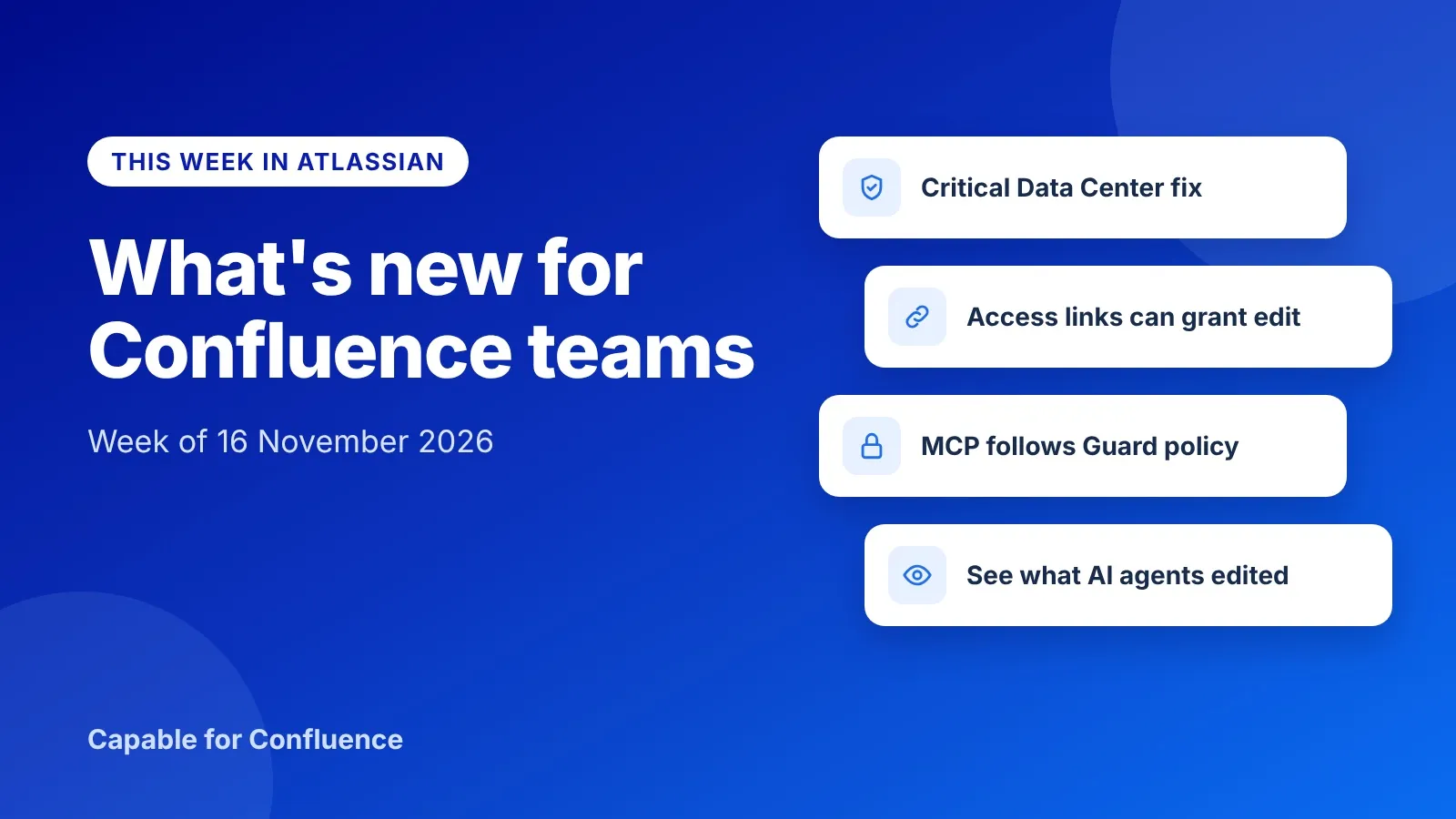
A critical fix for older Confluence Data Center, access links that can grant edit, MCP follows your Guard policy, and agent edits get labelled.

Each week we round up the Atlassian changes that matter if you run or use Confluence: what changed, who it affects and what to do about it, with a link to Atlassian's own source for every item. Developer and Marketplace news is left out unless it changes something for admins.
This week: a critical security fix for Confluence Data Center 9.x and earlier, plus the November security bulletin due on Tuesday, access links that can grant edit permission, Atlassian MCP now following your external sites policy, Confluence labelling what AI agents did to your content, and Rovo agents arriving in inline comments.

1. Critical fix for Confluence Data Center 9.x and earlier, and the November bulletin is due
What changed. Atlassian published a critical advisory, CVE-2026-90436, dated 9 November 2026 (Pacific time). It is a remote code execution flaw in Apache Axis, the third-party library behind Confluence's XML-RPC and SOAP remote API. Atlassian rates it critical, with a CVSS score of 9.3. It affects Confluence Data Center versions 1 to 9, and the fixed version is 9.2.28. Confluence 10.x and later are not affected, because the remote API was removed in 10.0, and Atlassian says Cloud sites are not affected and need no action. An instance is only exposed if the Remote API (XML-RPC & SOAP) setting is on, which has been off by default for new installations since version 3.0. Separately, Atlassian publishes its monthly security bulletin on the third Tuesday of the month, which this month is 17 November.
Who it affects. Admins of Confluence Data Center 9.x or earlier, particularly long-lived instances where the remote API was switched on years ago for scripts or integrations.
What to do. Patch to 9.2.28 or a later fixed version. If you can't patch straight away, Atlassian's mitigation is to turn off Remote API (XML-RPC & SOAP) under General Configuration, then Further Configuration. No restart is needed, but test first, because scripts, automations and apps that use the remote API may stop working. The advisory explains how to check the mitigation worked, and Atlassian recommends your security team checks affected instances for signs of compromise. Then read the 17 November bulletin when it lands and plan any fixes for your version line.
Sources: CVE-2026-90436: Remote Code Execution in Confluence Data Center · Atlassian security advisories and bulletins
2. Update: Confluence access links are announced as generally available, and they can grant edit
What changed. Last week we noted managed access links on Atlassian's roadmap for Q1 2027. Atlassian has now published a release note saying access links are generally available in Confluence. An access link shares one published page, live doc or whiteboard with people who don't have access to the space, either everyone licensed on your site (App) or anyone with the link (Public); public links become one type of access link. Each link carries a permission: Can view, Can view and comment, or Can edit. The release note's status still reads "Planned" with no timeframe, so it may not have reached your site yet.
Who it affects. Confluence admins, and anyone who relies on space permissions to decide who can see or change content. An access link gives access that does not show up as space membership.
What to do. Decide your default before the first links are created. Admins turn the levels on in Confluence administration under Security, then Access links, then Settings, and choose whether links start on, off or blocked in all spaces. If you're unsure, start with links blocked and turn them on for the spaces that ask, and make sure your content owners know that an edit link lets people outside the space change the page.
Source: Share content with access links
3. Atlassian MCP now follows your external sites policy, and service accounts can connect
What changed. Two admin changes to Atlassian's MCP server, which lets AI assistants work with your Jira and Confluence content, on 12 November. First, the Atlassian Guard external sites policy now applies when your managed users connect to Atlassian sites through MCP. You can block external sites or allow only selected partner sites, while your organisation's own sites stay available. If you already have an active external sites policy, it now covers MCP with no further action. The policy needs Atlassian Guard Standard. Second, organisation admins can let service accounts connect to the MCP server with OAuth 2.0 client credentials, so scheduled jobs and pipelines can get an access token without a person signing in. Access tokens last 60 minutes.
Who it affects. Organisation admins whose teams use AI assistants with Confluence, and anyone who runs automated jobs against Atlassian content.
What to do. If you have an external sites policy, check it does what you now expect for AI assistants as well as browsers. It's under Security, then Device security, then External sites in Atlassian Administration. If a team wants a pipeline to use MCP, give it a service account with access only to the sites it needs. Atlassian notes that the credential's scopes can't be changed after creation and the client secret is shown only once.
Sources: Atlassian MCP changelog · Manage access to external sites · Create OAuth 2.0 credential for service accounts
4. Coming soon: Confluence will show what AI agents did to your content
What changed. Two release notes marked "Coming Soon", with no date yet, add attribution for AI agents in Confluence. When an agent creates, edits or views content, Confluence will attribute the action to both the agent and the person who invoked it, in version history, comments, contributors lists and, for pages, live docs and blogs, the Analytics viewers list. You'll also see agent avatars while an agent is viewing, editing or commenting. It covers pages, live docs, blogs, whiteboards and databases, and applies to Rovo agents and to external tools connected through MCP; tools on the older MCP v1 appear as "External agent". Page history will also gain contributor tags and colour-coded highlights that separate human edits from AI edits.
Who it affects. Space admins and page owners who review content, and anyone in a regulated team who has to show who changed what.
What to do. Nothing to switch on yet. When it arrives, use it in your review routine: version history and the contributors list will tell you which pages agents have touched and who asked them to. If some pages need a named person to sign off before AI-assisted changes count, Capable for Confluence adds approvals to pages.
Sources: Clear visibility into agent activity in Confluence · Page history: Identify human and AI edits
5. Experiment: mention Rovo agents in Confluence inline comments
What changed. Atlassian is running an experiment, rolling out from November 2026 to selected Confluence Cloud customers, that lets people type @ in an inline comment and mention a Rovo agent. The agent can answer questions, summarise, analyse or suggest improvements for the highlighted text, and the exchange stays in the comment thread next to the content.
Who it affects. Confluence users on sites in the experiment, and admins who field questions about it.
What to do. Atlassian labels this an experiment, so expect it to change. Don't build a process around it yet. If it appears on your site, tell people that agent replies sit in ordinary comment threads that others on the page can read, and that the usual rule applies: check what an agent suggests before you act on it.
Source: Mention Rovo agents in Confluence inline comments
That's the week
Spotted something we missed, or want a change explained in more depth? Tell us and we'll cover it next week. Dates and prices are as Atlassian published them on 16 November 2026 and can change, so check the linked source before you act.
Try Capable for Confluence free on the Atlassian Marketplace →
Atlassian, Atlassian Guard, Confluence, Jira and Rovo are trademarks of Atlassian Pty Ltd. Apache and Apache Axis are trademarks of The Apache Software Foundation. Capable Works Limited is not affiliated with, endorsed by or sponsored by Atlassian or The Apache Software Foundation.